The deep web includes every page and resource a standard search engine cannot index: webmail inboxes, online banking and brokerage portals, private cloud storage, medical records, academic and legal databases, subscription news sites, internal company intranets, and government document portals. It is reached with an ordinary browser, often after a login, paywall, or direct link, and it is generally estimated to make up more than 90% of all online content. The dark web is a much smaller overlay network that requires the Tor browser and uses .onion addresses; it is not reachable through normal search engines or standard DNS. The key difference is access and indexing: deep web content is unindexed but accessible with standard tools, while dark web content is both unindexed and encrypted behind special routing software.
- Deep web = behind a login (email, banking) — most of the internet, mundane
- Dark web = a tiny Tor-only layer using .onion addresses
- Different criteria: “not on Google” vs “needs special software”
- The iceberg image wrongly equates “hidden” with “sinister”
- The dark web is under 0.01% of the internet
“Deep web” and “dark web” are used interchangeably all the time, and almost always wrongly. They are completely different things, and the famous iceberg image that supposedly explains them actually causes the confusion. Here is the difference, clearly.
What the deep web is
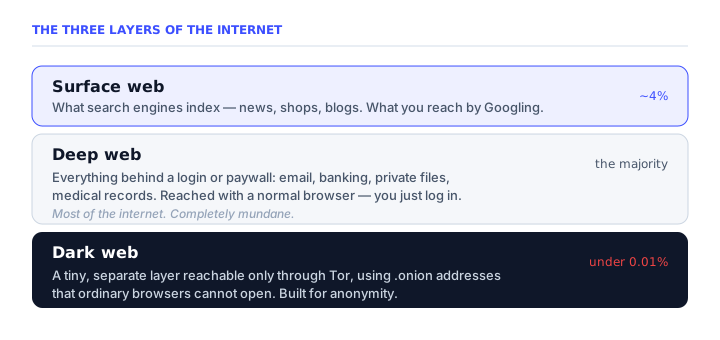
The deep web is everything a search engine cannot reach because it sits behind a login, a paywall, or a form. Your email inbox. Your online banking. Your medical records. A company's internal database. Netflix behind your password. You reach it with an ordinary browser — you just have to be allowed in. It is the vast majority of the internet, and there is nothing sinister about it. (For the opposite end of the spectrum, see dark web vs surface web.) You used the deep web before breakfast.
What the dark web is
The dark web is a small, separate set of sites that require anonymity software such as Tor to reach at all, using .onion addresses that ordinary browsers cannot open. It is a distinct thing, not a deeper version of the deep web.
The key difference
The deep web is defined by not being indexed by Google. The dark web is defined by requiring special software. These are different criteria — and being “hidden from a search engine” is not the same as being sinister. Your email is not indexed either; that doesn't make your inbox the dark web.
Why the iceberg image is wrong
The popular iceberg picture — a small surface tip, a vast “deep web” below, and a sinister “dark web” at the bottom — smuggles in a false idea: that “hidden” means “dangerous.” In reality the huge hidden mass is your own logged-in life and everyone else's: banking, email, private files. It is enormous and boring. The dark web is not the crushing depths of that iceberg; it is a small, separate chip of ice floating beside it.
| Layer | How you reach it | Example | Size |
|---|---|---|---|
| Surface web | A search engine | A news article you Googled | The visible part |
| Deep web | A normal browser, logged in | Your email and bank | The vast majority |
| Dark web | Tor, via .onion | An onion news mirror | Under 0.01% |
Frequently asked questions
What is the difference between the deep web and the dark web?
The deep web is everything behind a login or paywall — email, banking, private files — reached with a normal browser. The dark web is a tiny separate layer reachable only through Tor. They're different things; the iceberg image confuses them.
Is the deep web dangerous?
No. The deep web is simply everything behind a login: your inbox, your bank, your cloud files. You use it constantly and it's the most mundane part of the internet.
Is the dark web 90% of the internet?
No. That figure describes the deep web — mundane logged-in content, which is indeed most of the internet. The dark web is a fraction of one percent.
Is the deep web the same as the dark web?
No, and mixing them up is the most common mistake about this topic. The deep web is huge and ordinary; the dark web is tiny and requires Tor.
Do I use the deep web every day?
Yes. Every time you check email, log into your bank, or open a private document, you're using the deep web. It's simply the part of the internet that isn't publicly searchable.